Showing posts with label physical or chemical sunscreen. Show all posts

Thursday, September 6, 2012

How many times do you avoid sun at noon? {Your Opinion}

This has been my issue since quite long. So, I thought I would pose this question to you all. How easy or difficult do you think is avoiding sun at the peak time in the noons? For me, its always the noons when I can get my works done or find time to go out for shopping or anything!!! Especially, when on a vacation, you are always out in the noons. So, how do you exactly avoid the sun in the peak time of 10-4? 

For me, I do put on a lot of sunscreen which gives me protection and use umbrella and scarf both to avoid the sun. But, sometimes, its just not possible!! Anyway, reapplication of sunscreen is very important when you tend to stay out so please bear that in mind. Also, its very important to follow with an after-sun treatment so as to control some of the damage done to the skin. But, it is advisable to avoid sun at the peak time at any cost. 

So, what do you say?

Friday, August 24, 2012

Nivea Sun Moisturizing Lotion SPF 30 PA++ {Product Review}

Price: Rs 299 for 125ml

Pros
gets absorbed really easily
no white cast
is non-sticky as it says
also, water resistant
doesn't get greasy!!

Cons
the ingredients are not stable so has to be reapplied every one to two hours without fail
less on UVA protection coz its just PA++ and not PA+++

My Experience
When I had started using this after its counterpart, I was very happy because of no white cast issues. Its of the same consistency but gets absorbed really easily and can be applied in any amount. It doesn't even get greasy and doesn't feel sticky which is one of the best features of the product.
This time, I took out time to analyze the ingredients. Check out the image but I noticed that they do not have any stabilizing agents. [Read about sunscreen ingredients here.] Because of which, I did notice tanning on my hands because I do not reapply the sunscreen (which is very important) and I do go out in the noons, at the peak times when sun's rays are strongest.

Why there was no tanning with the SPF 50 counterpart? Probably because spf 50 provides more protection and it left a white cast which prevented the sun's rays from directly hitting the skin. I didn't analyze the other's ingredients either so this is just hazarding a guess!!

PS: Product sent by brand.

Other products from Nivea:

Saturday, August 18, 2012

Neutrogena Ultra Sheer Complete UV Moisture SPF 50+ PA+++ {Product Review}

Price: Rs 349 for 30ml

Pros
doesn't leave the skin dry if you skip moisturizer
no tint so you can apply enough sunscreen for full protection

Cons
expensive
not for oily skin
gets greasy sometimes (may be depends on skin type)

My Experience
I have been using this suncreen since the time it was launched in June. It comes in a 30ml pack and is way more expensive than its counterpart but I have not really found much of a difference. Anyway, the packaging is a white bottle with a very thin nozzle which dispenses a little product. 

The product is white and creamy in consistency but very thin. But, the weird thing is that even a little product does get greasy on the face so applying enough of sunscreen really becomes difficult. Also, a little excess of product and you are left with a white cast as well. I, almost always, had to blot out the excess of product after applying the product (after leaving it on for 15-20 minutes to get absorbed). 
Regarding the efficacy of the sunscreen, I am really not sure if it gives the same protection as the dry touch. Because, I did find my skin tanned and dark in between and since some days, I have been again using the dry touch which has considerably prevented my face from tanning. And, the skin is looking a little brighter as well. 
So, I am back to the previous sunscreen for now!! But, I do think that this sunscreen will suit the dry skin beauties really well. The dry touch is matte and this one is moisturizing. I do skip moisturizer whenever I use this and it never made my skin feel dry. The only issue is that this sunscreen finishes off in a month :( Well, remember that you have to apply sunscreen adequately for proper protection?? 

Btw, have you used this product? How was your experience?

Other products from Neutrogena:
Neutrogena Deep Clean Shampoo
Neutrogena Ultra Sheer Dry-Touch Sunblock
Neutrogena Body Lotion Light Sesame Formula
Neutrogena Rainbath Refreshing Shower and Bath Gel
Neutrogena French Milled Soap
Neutrogena Deep Clean Facial Cleanser
Neutrogena Clean Conditioner

Saturday, July 28, 2012

Nivea Sun Moisturizing Lotion SPF 50 PA++ {Product Review}

Price: Rs 399 for 125ml

Ingredients
I am skipping on this part because I couldn't get a better pic :( Sorry, guys!!!

Pros
- a medium consistency lotion which spreads easily
- smells nice
- does protect from tanning

Cons
- white cast!!!
- little issue with blending
- its PA++ and not PA+++ (the 3 +'s give highest protection against UVA rays)

My Experience
Since you all are already aware of my stringent requirements when it comes to sunscreen, doing an unbiased review is pretty difficult for me. I have needed a body sunscreen since long and this one came at the right time. And, Nivea being on the top of my beloved brands, the products did make me curious and I was very happy when I got a chance to try the products.

To begin with, the lotion is of a medium consistency and is pleasantly perfumed which doesn't bother the nose and doesn't linger on the skin either. It is of a soft yellow color and spreads easily on the skin. Now, this is where the trouble with the product begins. It spreads easily but it sits on top of my skin (which I have no issue with since its a sun protector).

But, it leaves a horrible amount of white cast which makes it absolutely impossible to use the exact amount of sunscreen which is actually required to achieve the said protection. One arm needs a tea spoonful of sunscreen which is around 5ml and I am hardly able to apply a really huge dollop on both hands :( 

I have not tested the sunscreen under stringent conditions because I got them a month back when I was in Delhi and in Hyderabad, it has been cloudy since then. In the meantime, I do go out in the afternoons around 11-2 PM slot and apply my sunscreen once right in the morning. 

Also, if you have read my posts on sunscreens, I have ranted a lot about the regular sunscreen ingredients being not so stable and break down on exposure to sun so I don't know if this sunscreen breaks down or not but its ingredients are all same. But, I won't say that my arms have tanned seriously or anything. 

Also, there is one claim which bothers me a bit. The sunscreen talks about immediate protection. As far as my knowledge goes, the sunscreen ingredients take 15-30 minutes to get activated and form a shield on the skin to protect from the sun's rays. So, as a precautionary measure, I always apply this at the same time I apply the sunscreen on my face. No, I haven't used this on my face as I didn't want the white cast.

One word about its water resistant power. Since it gives a very thick white cast, whenever I wash my hand, I can see a layer of the white film where the water touches my skin and initially, I had thought it to be water resistant. But, once I was caught up in the rain and the whole sunscreen literally bled from my hands and it was looking really bad coz I didn't have hankie or napkin to wipe off the cast and my whole hand was looking painted white!!! So, yes, its not water resistant in a torrent of rain but it does have some resistance. 

Also, since I have ranted so much about this product's negatives, let me state some positives about its counterpart product - spf 30 one. It doesn't give any white cast and disappears into skin really well!!! I am loving it and my arms haven't grown dark even though I apply it only once in a day!!!

PS: Product sent by brand for consideration.

Other products from Nivea:
Nivea Nourishing Body Milk
Winter Skin Care Lotions
Reminiscing Life through Beauty Products
Nivea Fruity Shine Dragon Fruit vs Pomegranate
Nivea Refreshing Cleansing Milk
Nivea Repair and Protection Lip Balm

Friday, June 29, 2012

Cellnique Paramedicals Derma Whitening Daytime Protection {Product Review}

Price: 57$ (Rs 3000 around) for 30ml

Ingredients

Pros
- its a mineral sunscreen as well
- spreads easily and is not too creamy

Cons
- it leaves a lot of white cast!!!
- pretty expensive!! 
- the pump didn't work for me :( 

My Experience
I am always on the look out for Zinc Oxide based sunscreens. So, this one caught my eye. I liked the packaging with the pump for the squeeze tube but, unfortunately, the pump didn't work for me. I had to screw open the pump and squeeze out the sunscreen. 

The sunscreen is white in color and light in texture but enough creamy but again, not too creamy. And, depending on various days, I needed extra moisturizing sometimes and sometimes not. The light texture of the product allows it to spread easily and evenly on the skin.

But, there is a huge hitch in this. Since it has both Zinc Oxide and Titanium Dioxide (I don't know the ratios), the product leaves a lot of white cast on the skin which is very annoying. I have tried using the product on my arms as well and same issue there. 

And, it is definitely expensive for 30 ml of a product which would probably last two months!!! It needs to be reapplied because its a combination of mineral and chemical sunscreen. I wish they do something regarding the white cast. Also, I didn't see any whitening or lightening of my skin tone.

PS: Product sent by brand.

Wednesday, April 18, 2012

Sunscreen and Myths {Skin Care}

[Source:healthmeup.com]
One of the reasons why I am doing many posts on sunscreen again is to raise the awareness that it is an important part of skin care routine. Today, I shall be talking about some of the myths concerning sunscreens. Hope this helps clear some of your doubts.

Myth: Sunblocks are better than Sunscreens
There is no such thing as sunblock and I have mentioned this in one of earlier posts too. Earlier, physical sunscreens (which include Zinc Oxide or Titanium Dioxide) were called sunblocks as they scatter or reflect the sun's rays when they fall int he skin as opposed to being absorbed and converted into heat energy which happens in case of using chemical sunscreens. 

But, now, FDA (Food and Drug Administration), US has passed out certain rules regarding the labelling of sunscreens in which it has banned the use of certain terms "sweat-proof, water-proof, sunblock, dermatologist tested" as they are misleading. I know these rules are not applicable on Indian products but it at least shows that these terms do not really mean anything. 

Even the labels of spf 70, spf 90, spf 100 have been banned. If a sunscreen provides higher protection, it should be labelled as spf 50+. You can see Neutrogena following these labelling standards to get an idea.  
""Waterproof," "sweatproof" or "sunblock" claims. Manufacturers cannot label sunscreens as "waterproof" or "sweatproof," or identify their products as "sunblocks," because these claims overstate their effectiveness. Sunscreens also cannot claim to provide sun protection for more than 2 hours without reapplication or to provide protection immediately after application (for example-- "instant protection") without submitting data to support these claims and obtaining FDA approval. (Source)"
Myth: SPF 100 gives me better protection than SPF 50
Spf 15 filters out 93% sun's rays, spf 30 filters out 96.4% sun's rays and spf 50 filters out 97.6% (near abouts). And, any spf higher than 50 gives only a marginal increase but there is no sunscreen which can filter out 100% sun's rays. For Indian climate, spf 30 is enough but if you are over-inclined, spf 50 is good. Anything higher is a false claim.

Myth: Layering of products with sunscreen will give me enough protection
I have talked of this issue earlier that spf's of various products do not add up!!! They all act as a single layer of sunscreen and provide the protection of the highest spf factor.

Myth: I don't need a sunscreen when indoors
UVA rays can penetrate through windows and glass. Read this post for more information about them. So, you need at least an spf 15 when staying indoors.

Myth: A drop of my new sunscreen keeps my face protected.
As a rule, you should apply one teaspoon or two fingers length of sunscreen to your face and neck. And, I know that's a lot. But, if you do not apply the said amount, the efficacy of your sunscreen is reduced according to the amount applied. So, even if you are using a spf 50 sunscreen, improper application might be giving you benefits of only spf 10 or 20. So, apply proper amount of sunscreen to protect yourself well.

These are some of the myths I have come across in my course of blogging, the top most being the confusion between sunscreen and sunblock. I hope this post helps to debunk those myths.

Saturday, March 31, 2012

Can aloevera be used as sunscreen? {Sunscreen}

[Source:infobarrel.com]
I was checking out my analytics page and saw this in the query section. And, then, I remembered many people had asked me this particular question earlier. So, I thought I would make a post of this.

Aloevera and Sun Protection
Aloevera, in itself, doesn't provide any sun protection of its own. It, in fact, cures the damages caused by sun's rays.So, you can call it more a after-sun treatment than calling it a sunscreen. Aloevera is a very versatile plant which can treat sunburns as easily as it can slow down the aging of the skin. The gel has healing properties instead of protection properties. 

Sunscreen
There is a reason for the existence of wide variety of sunscreens in the market. And, I have time and again asserted their importance in skin care. As a personal opinion, I would always assert that it is better to rely on products available in the market for such a product than trying out your own remedies without proper research.

My personal favourites are Zinc Oxide sunscreens but a stable chemical sunscreen also does a good job. Choose one according to your budget and be regular and diligent in its application, specially, in the summers.

Thursday, March 29, 2012

Summer Skin Care Essentials {Skin Care}

[Source:skinbeautyreview.com]
So, summers have started burning my skin here :( And, yes, I hate summers, a lot. I feel so hot and I don't really like AC's. I am more of a cooler gal!! Anyways, let us go through some summer skin care tips. And, I had meant to put up this post long long back but somehow laziness wore me down :S
  • Sunscreen: Must, Must and Very Essential!!!
  • Hats/Scarves/Umbrella (a light colored one): Accessories to protect yourself from direct sun rays. 
  • Don't go out after 10 and before 5. Rays are very strong. 
  • Tanning happens very easily in summers so protect your skin. 
  • Drink, Drink and Drink a lot and by drink, I mean water and herbal teas and fruit juices. 
  • Shades/Goggles: Get trendy with wrap-around shades which match your face. They not only add a style statement but also protect your delicate eye area from the sun rays and prevent fine lines and wrinkles.
Day - time Routine
  • Cleansing: Don't over-cleanse your face in the heat. I know sometimes the face feels a lot itchy and prickly and the immediate impulse is to wash it off which you should when you have just come back from prolonged exposure to the sun. But, not if your skin just feels the heat. Cleansing the face twice to at most thrice a day is enough. And, get a cleanser which helps control oil.
  • Toning: Very very important in summers as skin goes less on the hydration. Make sure you use face mists at regular intervals and apply it just before putting on the moisturiser to trap in the hydration.   
  • Moisturiser: Heat is building up so you really don't want a moisturiser which makes you look like an oil pan. Go light and easy on your body lotions and face moisturiser. Go for the oily moisturisers unless your skin too dry. They help control oil and keep the face shine-free.
    Check out some of my other posts under the heading of Summer Skin Care.

    Tuesday, March 13, 2012

    MVO Moisturizing Face Screen {Product Review}

    I had long back talked about my experience with MVO Everyday Sheer Coverage (ESC) and I mentioned about Moisturizing Face Screen (MFS) there. So, I am now ready to review this awesome product.


    Price: 40$ (Rs 2000 approx) for 60ml (and with rupee declining, its far more expensive!!!)

    Ingredients

    My Experience
    In a nutshell, this is the best sunscreen I have come across till date. It doesn't let me tan even a single bit. And, it is way too costly :( But, if I indulge myself in anything, it would be only this product ever because I have not found an equivalent of it yet which is inexpensive. So, let me talk about the product a bit.

    Its a tinted sunscreen because Zinc Oxide leaves a white patch behind. It comes in four tints which is less for the varying skin colors and sometimes, it might not really suit the skin tone. Since it is a Zinc Oxide based sunscreen, the texture is powdery (like Lactocalamine). And, yes, it is difficult to blend in the skin. Especially, when your skin is not at its best or not exfoliated properly.

    Well that was the bad and the good is that it goes very smoothly over oil or most of the moisturizers I have tried. Its supposed to blend in like a foundation only so a little patience is definitely required. Its a good makeup base and a little lip tint would look great. The finish of the product is matte and doesn't really make the face oily but yes, blotting papers would be useful if you are not going to sit in an AC.

    And, another good thing about the product is that it has amazing ingredients which nourish your skin at the same time. But, the best part of the product is that it stays for the whole day and you don't have to reapply unless you are all the time in the sun or you are sweating excessively when the Zinc Oxide may get washed off the skin.

    I have been using this since quite a time and almost every time I have loved the product except for when it gets difficult for me to blend it in and then, I come to know that I need to exfoliate  the my skin. Generally, exfoliation solves the blending problem so that makes my skin happy and glowing. Oh, something to remember is that double cleansing is very very necessary to remove the product. 

    PS: I am doing this review today because of Bridal Series going on. And, I wanted to share the secret of my glowing skin these days. And, if you can indulge in the expenditure, you should definitely give this a try. I don't know how I am going to get my next bottle. Btw, the 30ml bottle lasts for 2 months if used everyday so that's satisfactory at least (not inexpensive at all). Btw, MVO has free international delivery on or above 175$ so if anyone is interested, we can arrange a collective purchase. Drop me a mail :)

    Other products from MVO:
    Marie Veronique Organics After Sun Body Oil
    Marie Veronique Organics Everyday Sheer Coverage

    Monday, February 20, 2012

    How to get rid of skin tanning? {Skin Care}

    Happy Shivratri :)
     
    First thing is that I had long ago done a post on what causes dark knees and elbows and how to get rid of them so I advise you to please go through it.
    [Source: Google Images]
    Diet for Fairer Complexion
    I would only suggest a healthy and balanced diet which has all the possible nutritious foods according to your eating habits. Don't overdo anything. A cleaner body means lesser skin problems.

    How to remove the tan?
    The basic reason for skin darkness is excess exposure to sun and the excess melanin production resulting from the exposure. So, there are some things which one can do to prevent tan and remove it.
    • Apply Zinc Oxide sunscreen to prevent tanning. And, even if you are not able to find any physical sunscreen, don't forget to use a normal sunscreen which is good and reliable and has spf 30 or more. 
    • Tomato and potato are great for bleaching and removing tan and bringing a glow to the face. 
    • Exercise is very very important for bringing a fresh glow to the face and regular hydration of the skin from outside and inside helps the skin maintain a healthy glow and a radiant skin. 
    • Always use accessories like scarf and umbrella when outside in the sun. It helped me most to prevent skin tan. 
    Have you any ideas on how to prevent tan?

      Sunday, September 25, 2011

      Marie Veronique Organics Everyday Sheer Coverage {Product Review}

      I mentioned a while back that I had won the MVO giveaway and this product came as one of the samples. So, I finished the sample and wanted to share my experience. So, kindly don't take this as a proper review.

      Price: 50$ (Rs 2500 approx) for 60 ml (yeah, really expensive!!!)

      What does MVO say about the product? 
      • Provides essential every day UVA/UVB protection and defends against premature aging with a unique combination of natural humectants, emollients and anti-oxidants.
      • Evens skin tones and absorbs into the skin leaving a lovely matte finish
      • Provides anti aging support with beta glucans, glucosamine, and powerful anti-oxidants such as coffee fruit extract.
      • Prevents moisture loss from exposure to the elements with red raspberry seed oil and broccoli seed oils
      • Made with non-micronized zinc oxide, a physical sun block that reflects UV rays without releasing wrinkle and cancer-causing free radicals
      • For use every day, rain or shine.
      Available in Extra light, Light, Medium and Dark Tint. For Indian skin, light and medium tint would suit well.

      Shake well before use and keep in a cool place. Apply liberally and evenly before sun exposure. Reapply every 2 hours and after swimming, sweating or towel drying. Safe for all ages. If irritation develops discontinue use and consult a physician. 

      Ingredients
      No harmful chemicals, nanoparticles, parabens, fillers, waxes, or fragrances.
      Active ingredient: 16.6% non-nano zinc oxide
      Ingredients: Camellia sinensis (green & white tea), non-nano zinc oxide, vegetable glycerin, Brassica oleracea italica (broccoli seed oil), Prunus avium (cherry kernel seed oil), emu oil, Punica granatum (pomegranate seed oil), Rubus idaeus (red raspberry seed oil), Tocopherol (vitamin E), Calodendrum capense (yangu oil), Cosmocil CQ*, xanthan gum, n-acetyl glucosamine, lecithin, potassium sorbate, pearl powder, Rosemarinus officinalis (rosemary oleoresin), beta glucan, Coffea arabica (coffee fruit extract), Hydrolyzed silk (silk powder), Rosa centifolia (rose) essential oil, Citrus aurantium bigaradia (neroli) essential oil, Helichrysum italicum (helichrysum essential oil), Cistus incanus (cistus) essential oil, iron oxides
      Amazing Ingredients!!! I can't get enough of them :) Btw, MVO is an organic brand.

      My Experience
      this is the medium tint
      One thing which I regret about this product is that it is just spf 20 and not enough for a tropical climate of India. I ordered the medium tint of the Moisturizing Face Screen so this also came in the same tint. The product is lighter in consistency and gets absorbed really quickly into the skin. Well, if I actually say, it gets absorbed too quickly so it is better to apply it as dots on the face and blend in as compared to rubbing on the hands and then applying. And, I think its anti-aging ingredients do work. I felt my face was a little firmer when I was using this. And, its Zinc Oxide is great at protecting from the sun. The only wish is if it had been spf 30. 

      little shinier than the other but gets absorbed quickly
      Another thing to note is that as I said in my previous post, physical sunscreen ingredients do leave a white cast on the skin. So, the tinted ones are available in the product. But, since Zinc Oxide is so high in concentration (24% is the maximum allowed concentration of Zinc Oxide by FDA rules and the product has 16% around), there is a little powdery texture to the product and it doesn't feel silky smooth as other sunscreens do. This makes the blending a little harder. But, when you get used to it, its not much of a concern. I have applied it directly on the skin without moisturizing and using various moisturizers and face oils too and I didn't face any problem of blending even once. And, since it has a tint, it also provides a decent coverage and evens out the complexion. But, of course, you can't use it as makeup as far as I understand (a doubtful point, don't believe me coz I know nothing about it!!!). It gives a matte finish but might also become semi-matte depending on your skin type. 

      For dry skin, it gets absorbed well and provides moisturization too. For oily and combination skins, it might be a little dewy and you might need a bit of powder to set it after some time depending on the oil on your face. But, its a score of times better than chemical sunscreens which make your skin look like having been dipped in oil. And, I have been there so I am thankful. It might give a shiny appearance for sometime but give it 2-3 minutes and it settles comfortably into the skin. One squirt of the product is enough for face and another squirt for neck and exposed chest. I would advise to apply it just like a foundation coz you want the sunscreen to sit evenly on your skin and protect your skin from sun's rays. Touching and tugging at the skin wouldn't help coz it might bring off the Zinc Oxide from the skin. 

      Regarding application, when you are staying indoors and during cloudy days when there is no sun and during winters when sun is again obscure, one application in the morning and another in the afternoon is probably enough. I surely didn't apply it every two hours as it is advised coz I was indoors most of the time. But, if you are outside in hot sun or sweating profusely or swimming, it is advisable to reapply the sunscreen in regular intervals (two hours is the general idea). Btw, did I mention that it prevents tanning of the skin which is a huge bonus!!! I didn't tan since I have been using it. And, of course, you need to double cleanse to remove the sunscreen whether its physical or chemical so don't forget that.

      Instead of making my recommendation because it was just a sample and I used it for very less time, I would conclude by saying that if I am to try it again, my preference would be a higher spf sun screen and I would love to use the Anti-aging oil instead at night to revive my skin. And, if this product would ever be changed to spf 30, then I might definitely prefer this over the Moisturizing Face Screen because I found it gives a better finish than that.

      PS: The comparison in this post is with MVO Moisturizing Face Screen.

      Saturday, September 24, 2011

      Zinc Oxide vs Titanium Dioxide {Sunscreen}

      [Source:holistickid.com]
      So, we talked about physical and chemical sunscreens in this post. I explained that I do not prefer chemical sunscreens because they produce free radicals in the body. So, now, we come down to physical sunscreens. Now, there are only two ingredients which has the properties of being physical sunscreens - Zinc Oxide and Titanium Dioxide.

      Now, do you remember my post on the sunscreen breakout problem?? It was posted quite long back. In that post, I had simply stated that a sunscreen with Zinc Oxide will solve the breakout problems. Why did I not state anything regarding Titanium Dioxide? Let's see if I can explain it.

      Zinc Oxide
      It is the best broad-spectrum UV filter known till now. And, it doesn't cause any allergic reactions on the skin too. In fact, Zinc Oxide is pretty good for acne skin because of its anti-bacterial property. It just sits and disperses the light falling on the skin without allowing it to get to the skin surface. It doesn't get absorbed by the skin. But, there are certain downsides to this ingredient. 

      Zinc Oxide is notorious for leaving a white cast on the skin. The Zinc Oxide sunscreens are thick and a little powdery in texture which might leave a powdery cast on the skin. These sunscreens do not blend on the skin very easily too. It takes a little getting used to the texture of the product. 

      Titanium Dioxide
      So, you might have heard the debate whether Titanium Dioxide is poisonous or harmful to the skin or not. Ok, so let me first say, this is the second best ingredients for sunscreen but it doesn't give a broad-spectrum protection. It lacks UVA spectrum protection. And, it is also known to be allergic to the sensitive skin. Well, Titanium Dioxide is one of regularly used ingredients in mineral makeup and if mineral makeup breaks you out, Titanium Dioxide allergy might be one of the factors. Even Titanium Dioxide leaves a white cast like Zinc Oxide.

      So, let us first say how this ingredient protects from sun's rays. It uses both absorption and dispersion methods. So, yup, you might ask me if it doesn't produce free radicals? Well, I have been trying to hunt down for that answer and this is what I found: http://personalcaretruth.com/2011/01/does-titanium-dioxide-cause-free-radical-damage. Well, check out the article for detailed explanation. 

      Does Titanium Dioxide produce free radicals?
      Well, there are two types of Titanium Dioxide which can be used in the products - Rutile and Anatase. These are the polymorphs of original Titanium Dioxide and thus, differ in certain properties. So, as it comes out, rutile is less photoreactive than anatase form because it has highest refractive index of all the known minerals and it also has high dispersion properties which means that rutile Titanium Dioxide reflects the UV light more than absorbing it. 

      Now, you need to be concerned about which form is present in your product. So, the answer given is that generally it is the rutile form which is more commonly used but in case of doubt, the manufacturer of the product should be contacted. Not a very good answer but the summary is that you need not be bothered about the absorption because it is very less likely to damage the skin.

      What would I choose?
      Well, my answer would be Zinc Oxide as it is broad-spectrum and more effective but I definitely wouldn't mind Titanium Dioxide in mineral makeup. That would add some sun protection to the makeup you are using.

      Wednesday, September 21, 2011

      What are UV Radiations? {Sunscreen}

      Ok, so I have never really discussed what exactly are UV radiations and how are they harmful for us even though I have done many articles on sunscreens. So, for those who are not aware, the UV radiations are the ones emitted by the sun and these are extremely harmful for the skin. These radiations are known to cause various type of skin cancers, affect the immune system and of course, regular skin disorders like sunburns, wrinkles, fine lines and age spots. Now, there are two types of radiations which are most harmful and penetrate the Earth's atmosphere - UVA and UVB. In case  you are thinking that there are no other radiations emitted by sun, they are all (UVC and other radiations from the sun and other stars) absorbed by the ozone. That again is very important reason why we should help reduce global warming otherwise more radiations would penetrate Earth's atmosphere and harm the human beings. Even UVA and UVB do get blocked to a lot of extent but our wearing out the ozone layer is causing some havoc.

      UVA is mainly responsible for aging of the skin. It is the dominant of the radiations and penetrates the skin more deeply causing the wrinkling and damaging the skin. It also results in the tanning of the skin. And, may also initiate skin cancers. And, UVB results in the skin reddening and sunburns. It contributes to tanning and aging but mainly plays a key role in development of skin cancer. UVB is intense in the time from 10AM - 4PM all the year round and is more intense on reflective surfaces like snow and ice. It doesn't penetrate the glass much. UVA rays penetrate glass, though, even the tinted ones!!!

      Now, one more damage which the UV rays can do is damage to the eyes. So, it is advised to get shades or make your glasses with photo-chromatic lenses so that they are able to deflect the sun rays. And, do not forget to wear sunscreen even if you are staying inside. Both UVA and UVB can penetrate through open windows.

      Now, in this post, I mentioned a small point that spf factors block UVB radiations. Well, yes. They do not in general block UVA radiations. There is a star system which determines the sunscreen's efficiency in blocking the UVA rays so basically, you are only protecting yourself from UVB. Currently, I do not think there is any sunscreen in India with star ratings. That's a downside of getting even the best sunscreens.

      Monday, September 19, 2011

      Sunscreen Ingredients {Sunscreen}

      Now, I am not sure but have you ever come across the term 'Sunblock'. Well, let me then tell you that this word doesn't hold good at all. The reason being FDA (US federal drug administration) has passed out some guidelines regarding the labeling of sunscreens in which it makes it clear that the term 'Sunblock' is misleading and can't be used anymore. Now, if you guys remember, I had done a very old post, my first post on sunscreens in which I had explained two types of sunscreen - chemical and physical sunscreens. So, yup, that's the only classification which holds.

      Sunscreen (Chemical Sunscreen)
      • applied half hour before going out
      • absorbs the sun rays to prevent damage to the skin
      • has to be as close to skin as possible for maximum protection
      • has to be reapplied to ensure effectiveness
      Sunblock (Physical Sunscreen)
      • has to be applied immediately before going into sun
      • the ingredients deflect sunlight from the skin instead of absorbing
      • should be the top most layer of products applied so as to deflect the rays
      • has to be reapplied only if one is perspiring or during swimming or when it is raining or in any case where there is a likelihood of the product being washed away

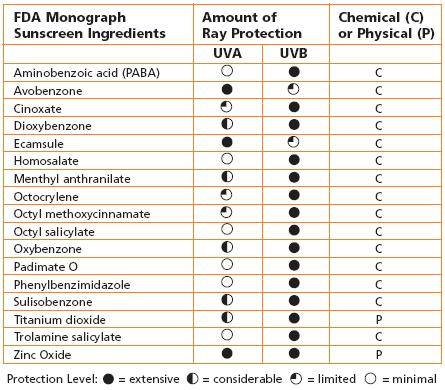
      Approved Sunscreen Ingredients Chart from September 2006 given out by FDA
      So, if you are buying sunscreen, make sure your sunscreen has any or some of these ingredients listed above. Generally you will find avobezone and oxybenzone are most used in products like Lotus, Lakme and even in the dermatologist prescribed sunscreens. Now, from the chart, you can easily infer that though most of the ingredients provide adequate UVB protection, there are very few ones good at providing UVA protection.

      What is Helioplex?
      Helioplex is a patented technology of Neutrogena. As I mentioned above, avobenzone and oxybenzone are the most commonly used ingredients.

      Avobenzone is a UVA blocker and Oxybenzone is UVB blocker but both ingredients are highly unstable, especially Avobenzone which breaks down pretty quickly (within half hour) when exposed to sunlight. So, Helioplex is a stabilizing formula developed by Neutrogena which harnesses the potent characteristics of Avobenzone and Oxybenzone to provide a broad-spectrum sunscreen which is stable.

      What is Mexoryl?
      Have you come across this term? Well, it was all in rage till very recently as the new 'sunscreen'. So, referring back to the chart, check out the ingredient called 'Ecamsule'. This ingredient is marketed by the name of 'Mexoryl' and the very reason it might have become very popular would be attributed to its characteristic of being a very good filter of UVA but unfortunately, it doesn't give the broad-spectrum protection. This is a patent of Loreal. Check out this post by Sesame on better comparison of Helioplex and Mexoryl.

      P vs C 
      Now I come to the most important part of the post. Referring back to the chart, you would find the fourth column very interesting. Most of the ingredients are chemical and only two are physical ingredients - Zinc Oxide and Titanium Dioxide. Now, what makes physical ingredients different from chemical ingredients? 
      • Chemical Ingredients absorb the UV rays, as I mentioned above. So, where do this absorbed energy go? Inside our bodies. And, they becomes manifested as something which you would be familiar with 'free radicals'. Yup, the very thing which makes us age. 
                Physical Ingredients just sit on the skin and deflect the sun's rays.
      • Chemical Ingredients are highly unstable and breakdown in the sun very easily. That is why one is supposed to apply the sunscreen frequently. 
             Physical Ingredients do not break down in sunlight and need not be reapplied frequently as frequently as the chemical sunscreens.
      • Chemical Ingredients do not leave any white cast on the skin. 
                Physical Ingredients do. A disadvantage.

      Sunday, September 18, 2011

      Use sunscreen 365 days a year {Sunscreen}

      Ok, so this is a sincere advise to people who love to skip on sunscreen. Yes, even I do that!!! Or, rather used to do that and now I have become diligent and force myself to apply the sunscreen everyday as soon as I moisturize my face. The reason is that it helps to keep you young by counteracting the effects of sun rays on skin. And, I have kept my resolve on and off since May so I can safely say that this happens to be true. Daily usage of sunscreen does keep you younger for a longer time or rather prevent wrinkles and age spots which tend to appear as you age. I know it is difficult to find a good sunscreen but for those who haven't tried, you can go for Neutrogena Ultra Sheer or if you have the dough to spend, I would definitely advise MVO Moisturizing Face Screen or Everyday Sheer Coverage. MVO has physical sunscreens and they definitely work!!! Better than chemical ones and you don' have to keep on reapplying them all day!!! And, of course, you should apply adequate amount of sunscreen for proper protection. That is very very important. And, do not skip on sunscreen even for a single day.

      Full strength sunscreen in summers is a must but many people tend to forgo it in rainy seasons or cloudy days or even in the winters. But, on cloudy days, there might be a possibility that UV radiations increase so it is always safe to apply a full strength sunscreen. The reason is that though clouds are handy in deflecting the UV rays passing through them, they also reflect the UV rays if the sun is out and not obscured by the clouds. So, don't be fooled by clouds and leave the sunscreen at home. And, regarding winters, yeah you can go little less on the strength that is the spf factor if you wish to. But, forgoing it not at all a good idea. The UVA rays specially remain strongest during the daylight hours all the year round.

      spf 15 - filters 93.3% UVB
      spf 30 - filters 96.7% UVB
      spf > 30 - filters around 97% UVB 
      So, clearly any sunscreen having spf more than 30 is not very helpful and efficient. These are mainly marketing tactics so you can protect your skin as well with spf 30 as you will with spf 100. 
      I would recommend going for spf 30 in general all round the year because it provides the best protection. It is proven through research that factors higher than 30 do not in anyway provide extra protection as compared to spf 30 so it is better to stick with spf 30 and make sure to reapply it regularly. And, clothing is very important to protect from the sun's rays. So, do take care that you are amply covered.  

      Thursday, September 8, 2011

      How much sunscreen do you apply? {Sunscreen}

      I have read so many reviews on other blogs and sites especially on sunscreens. And, I have found out one terrible mistake which people make - amount of sunscreen to be applied for proper protection. Many people apply a drop of the product or equivalent. That got me thinking about the amount of sunscreen which should be applied for optimal protection. And, then, I came across a comment in facebook by Renne Rouleau which said that two finger length amount of sunscreen should be applied to every part of the body. 

      So, I tried to find more about what is the ideal amount of sunscreen which should be applied. And, the information I came across was correct. If one applies amount of sunscreen which can be traced along the length of their middle finger, they get adequate protection of 45 minutes and if they apply the amount traced across both their index and middle finger, they get optimal protection of 2 hours and 15 minutes. And, this amount of sunscreen has to be applied to every part of the body. The body is divided into 11 parts - face and neck, upper back, lower back, chest, stomach and waist, both upper thighs and lower thighs including feet. So, you need to apply two finger length amount of sunscreen for every part of the body for optimal protection. And, sunscreen has to be applied every half hour according to the article I am referring to.

      PS: The information provided in this post has been taken from this article. Kindly refer to it for more details. The link to this article was shared by Tanveer of Addicted to Blush so very thanks to her!!!

      So, how much of this advice do I follow? Ok, no, I do not reapply any sunscreen after going into the sun. Not even during my vacation. And, I apply only a finger length amount to my face and neck. May be it is pretty less but frankly the products is so heavy and makes my skin so oily that there is no scope for reapplication unless I wash off my face and do the whole routine again which is again quite an impossible thing. But, how so ever much one might be diligent with sunscreen application and reapplication, it is always best to stay out of sun. I try to follow that rule most of the times :)

      PS: This article is relevant for chemical sunscreens. 

      Friday, December 10, 2010

      Sunscreen is breaking you out? {Sunscreen}

      This is some tip I read some where regarding the usage of sunscreen. Use a Zinc Oxide based sunscreen if your sunscreen is breaking you out.

      Zinc Oxide is a great sunscreen agent and even a stronger antiseptic and inflammatory agent which helps the comedogenic (prone to blocked pores) skin. The best part is that zinc oxide based sunscreen is more effective and less harmful as compared to chemical sunscreens available in the market. For more information on physical and chemical sunscreen, please refer to this post.

      Thursday, April 15, 2010

      What should you know about sunscreens?

      Referring to my earlier post on Sunscreen for anti-aging skin care, I would like to add my recent personal experiences. In the above-mentioned post, I have talked about the physical sunscreen to be better than chemical sunscreen because of the various harmful chemicals present in them.There was a bit of information I forgot to include. The chemicals present in the sunscreens (chemical or even micronized and nanonized zinc oxide and titanium dioxide, for that matter) get absorbed by our skin and they form deposits in our body and produce free radicals which accelerate aging in the body. So, contrary to the popular belief, sunscreens do not prevent aging. But, they do protect you from harmful sun rays which can cause your skin to become dark and develop dark spots or patches and even, skin cancer. 
      Speaking of the protection from sun, I have till now tried some 3-4 herbal, physical or natural sunscreens and believe me, they did not provide proper protection against sun. So, I had to ultimately switch back to chemical sunscreens. And, for the time being, I am quite contended with these sunscreens because they do take care of my skin very well. And, regarding the free radical generation within the body, I am taking care of it through my nutritional needs. Drinking green tea, eating lots of fruits (specially rich in Vitamin C) provide lot of anti-oxidants which can fight against the free radicals. So, I would advise you to take care of your skin problems inside and out. And, sometimes, being natural is not an option. Before I forget, I'll repeat it here again: eat lots of tomatoes and spinach (all green leafy vegetables) to increase your skin resistance to sun's rays. 

      A note at the end: I have tried both over-the-counter products available at the stores and prescription-based products and have found dermatologist prescribed sunscreens are much effective. So, I would advise you all to go for a visit to a good dermatologist and get yourself a good sunscreen. Please choose your dermatologist very carefully.